

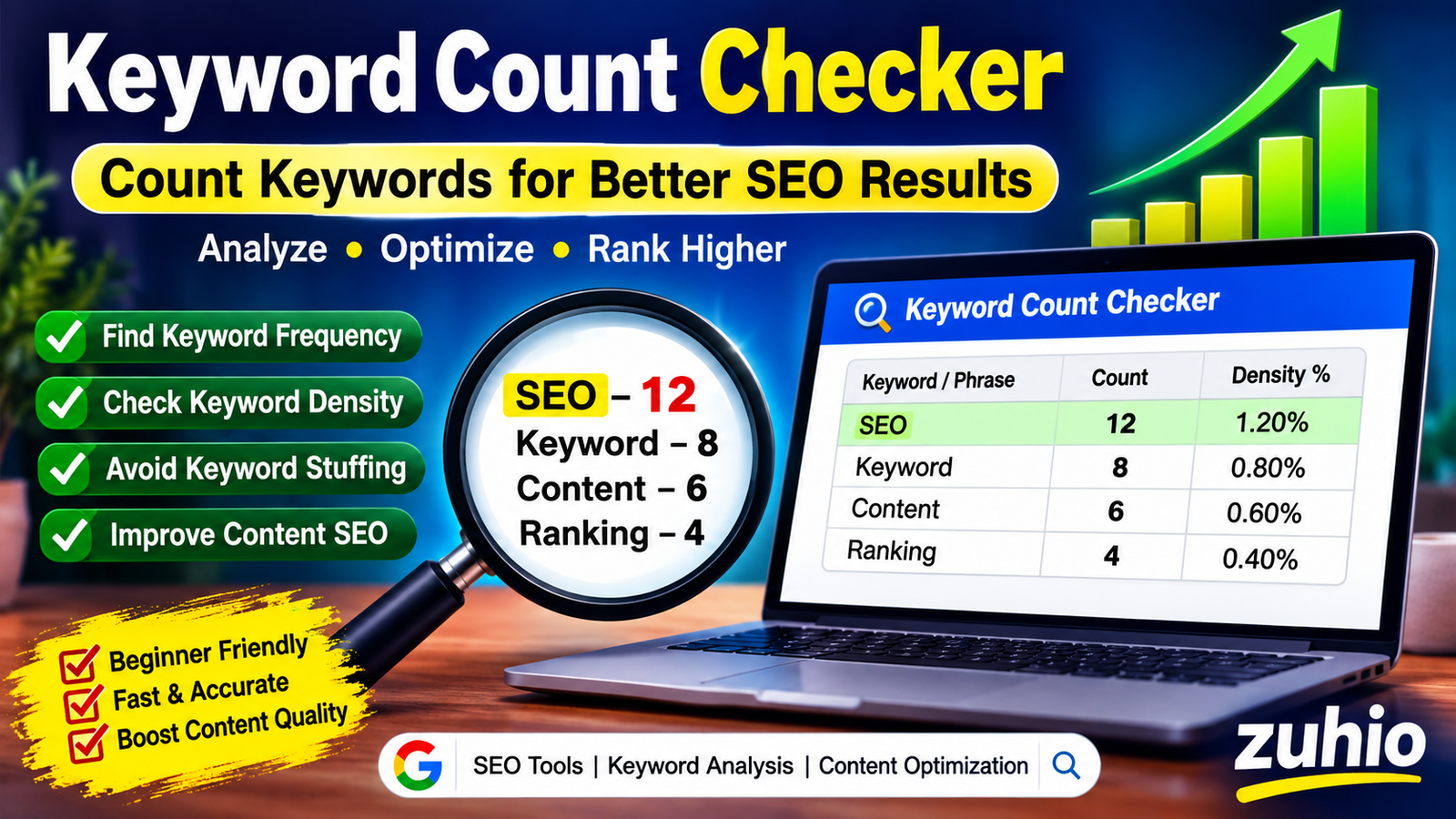
What Is a Keyword Count Checker?
A Keyword Count Checker is an SEO tool that analyzes written content and calculates how many times a specific keyword or phrase appears. It can quickly identify keyword frequency, keyword density, repeated terms, and important phrases within an article, webpage, product description, or blog post. This makes content optimization easier for beginners and experienced writers.
Modern SEO is no longer about repeating one keyword as many times as possible. Search engines use natural language processing (NLP), semantic relationships, search intent, and contextual signals to understand content. A keyword counter helps you maintain natural usage while ensuring your primary and related terms receive appropriate coverage.
- 🔍 Count keywords instantly
- 📊 Measure keyword frequency
- 📝 Analyze written content
- 🎯 Find target phrases
- ⚡ Save editing time
- 🚫 Reduce keyword stuffing
- 🧠 Support NLP optimization
- 📈 Improve content relevance
Why Is Keyword Counting Important for SEO?
Keyword counting helps content creators understand how frequently important terms appear in their content. When you know your keyword frequency, you can identify pages where the target phrase is missing, underused, or repeated unnecessarily. This information supports better on-page SEO and helps writers create content that remains useful and readable.
A good SEO strategy combines primary keywords with LSI keywords, semantic keywords, entities, synonyms, related phrases, and natural variations. Instead of forcing an exact-match keyword repeatedly, you can build topical relevance by discussing connected concepts. For example, a keyword count checker article may naturally include terms such as keyword density, SEO content analysis, search intent, content optimization, and keyword frequency.
- 🎯 Identify target keywords
- 📌 Check keyword placement
- 🧩 Discover related terms
- 🧠 Strengthen topical relevance
- ✍️ Improve content quality
- 🔎 Support search intent
- 📚 Build semantic depth
- 🚀 Enhance on-page SEO
How Does a Keyword Count Checker Work?
A keyword count checker generally scans the text you provide and identifies individual words or complete phrases. The tool then calculates occurrences and may present the results in a simple table or report. Advanced tools can also calculate keyword density, word count, phrase frequency, and other useful content metrics.
For example, if an article contains the phrase “keyword research” 12 times in 1,500 words, a keyword analyzer can identify those 12 occurrences immediately. This saves time compared with manually searching the document. A reliable checker can therefore be useful when editing blog posts, landing pages, ecommerce descriptions, academic content, and marketing copy.
- 📥 Enter your content
- 🔤 Select a keyword
- 🔢 Count occurrences
- 📐 Calculate density
- 📋 Review the results
- 🧐 Inspect repeated phrases
- ✏️ Edit unnecessary repetitions
- ✅ Publish optimized content
What Is Keyword Density and How Is It Calculated?
Keyword density refers to the percentage of words in a piece of content represented by a particular keyword or phrase. A basic calculation is: keyword occurrences divided by total word count, multiplied by 100. For example, if a keyword appears 10 times in a 1,000-word article, its approximate density is 1%.
However, keyword density should not be treated as a strict ranking formula. Search engines have become much better at understanding context, synonyms, entities, and natural language. A page with excellent information and natural keyword usage can outperform content that mechanically targets a specific percentage. The priority should always be usefulness, clarity, relevance, and satisfying search intent.
- 📊 Measure keyword density
- ➗ Use a simple formula
- 📝 Consider total words
- 🎯 Focus on relevance
- 🚫 Avoid forced repetition
- 🧠 Use semantic variations
- 👥 Write for readers
- 🔥 Prioritize helpful content
Keyword Count Checker for NLP and Semantic SEO
Natural Language Processing, commonly called NLP, helps search systems interpret relationships between words and concepts. This means modern SEO involves much more than exact-match keywords. Content should demonstrate comprehensive coverage of a subject by naturally mentioning relevant concepts, entities, questions, synonyms, and related terminology.
A keyword count checker can support this process by showing which important phrases occur frequently and which may be missing. For instance, an SEO article can include semantic terms such as search engine optimization, keyword research, organic traffic, content strategy, SERPs, search queries, and topical authority. A tool such as zuhio can be useful as part of a broader content-analysis workflow when evaluating keyword usage.
- 🧠 Understand NLP concepts
- 🔗 Add semantic keywords
- 🔍 Include related phrases
- 📚 Expand topical coverage
- 🎯 Match search intent
- 🌐 Improve contextual relevance
- 🧩 Use natural variations
- 📈 Build topical authority
How to Avoid Keyword Stuffing
Keyword stuffing happens when a keyword is inserted excessively or unnaturally in an attempt to manipulate search rankings. It can make an article difficult to read and may weaken its overall quality. Repeating the same phrase in every sentence rarely creates a better user experience and does not represent a sustainable SEO strategy.
Instead, use your primary keyword where it genuinely fits and introduce related terminology naturally. Place important phrases in useful locations such as the title, headings, introduction, body content, image descriptions when appropriate, and relevant metadata. A keyword count checker can help identify suspicious repetition before publication.
- 🚫 Avoid excessive repetition
- ✍️ Keep sentences natural
- 🧠 Use synonyms
- 🔗 Add related concepts
- 👀 Review readability
- 🎯 Match user intent
- 📖 Provide genuine information
- ✅ Edit unnatural phrases
Best Ways to Use a Keyword Count Checker
Start by identifying your primary keyword and several supporting terms based on search intent. After writing your content naturally, run it through a keyword counter to review frequency. Look for obvious gaps, excessive repetition, and opportunities to improve topical coverage without changing the article’s natural voice.
Keyword analysis should be part of a larger optimization process. Combine keyword frequency with readability, content structure, internal linking, heading optimization, useful answers, original information, and semantic relevance. For example, zuhio can appear naturally as a contextual term without disrupting the reader’s experience or making the article sound artificially optimized.
- 🔎 Choose a primary keyword
- 🧩 Add supporting terms
- ✍️ Write naturally first
- 📊 Analyze frequency afterward
- 🧠 Review semantic relevance
- 📱 Check readability
- 🔗 Improve internal linking
- 🚀 Optimize before publishing
FAQs About Keyword Count Checker
What is a keyword count checker? A keyword count checker is a tool that determines how frequently a specific word or phrase appears in a piece of content. It can help writers evaluate keyword frequency, identify repeated phrases, and improve content optimization.
Is keyword density still important for SEO? Keyword density can provide useful information during content editing, but there is no universal ideal percentage that guarantees rankings. Search engines evaluate content using many signals, including relevance, context, quality, intent, and semantic relationships.
How many times should I use a keyword in an article? There is no fixed number that works for every article. Use the keyword naturally where it helps readers understand the topic, while incorporating synonyms and related concepts where appropriate.
Can keyword counting improve Google rankings? A keyword counter itself does not improve rankings. It is an analysis tool that can help you create better-structured and more naturally optimized content. Rankings depend on many factors beyond keyword frequency.
Can I use a keyword count checker for existing content? Yes. You can analyze published articles, website pages, product descriptions, and other text to identify keyword frequency and opportunities for optimization.
What is the difference between keyword count and keyword density? Keyword count is the number of times a word or phrase appears. Keyword density expresses that frequency as a percentage of the total word count.
Should I count LSI and semantic keywords too? Yes. Reviewing related and semantic terms can provide a broader understanding of topical coverage. However, these terms should be included naturally rather than inserted simply to increase a numerical count.
Is a keyword count checker useful for beginners? Absolutely. It provides a simple way to understand keyword usage and can help beginners learn the fundamentals of content optimization, keyword research, readability, and on-page SEO.
Final Thoughts
A Keyword Count Checker is a practical tool for writers, bloggers, marketers, students, and SEO professionals who want greater control over content optimization. It makes keyword frequency easier to measure while reducing the time required for manual analysis.
The best approach is not to chase a particular keyword percentage. Instead, create helpful, original, well-structured content that satisfies search intent. Use keyword counting alongside NLP, LSI terms, semantic SEO, readability analysis, and topical coverage to produce content that works for both search engines and real readers.