

What Is CGPA?
CGPA stands for Cumulative Grade Point Average. It is a numerical value used by schools, colleges, and universities to represent a student’s overall academic performance across multiple subjects or semesters. Instead of showing marks for every course, CGPA provides a combined academic score based on grade points earned.
CGPA is commonly calculated on scales such as 4.0, 5.0, or 10.0. The exact conversion from CGPA to percentage depends on the institution, education system, and official grading policy. Therefore, students should always check their university’s conversion formula before using a CGPA percentage conversion.
- CGPA means Cumulative Grade Point Average.
- It measures overall academic performance.
- CGPA combines performance across courses.
- It is different from semester GPA.
- CGPA can use different grading scales.
- Common scales include 4.0 and 10.0.
- Higher CGPA generally indicates better performance.
- Institutions may use different conversion rules.
What Is a CGPA to Percentage Scale?
A CGPA to percentage scale is a method used to convert a cumulative grade point into an equivalent percentage. This conversion is useful when an application, scholarship, job, or educational institution asks for percentage marks instead of CGPA.
There is no single universal formula that applies to every institution. Some universities use a simple multiplication formula, while others provide an official conversion table. For example, a 10-point CGPA may be converted differently depending on the university’s academic regulations.
- Converts CGPA into percentage.
- Helps compare academic results.
- May differ between universities.
- Can use an official conversion formula.
- Some institutions provide conversion certificates.
- Percentage represents marks out of 100.
- CGPA represents grade-point performance.
- Always verify the official academic policy.
How to Convert CGPA to Percentage?
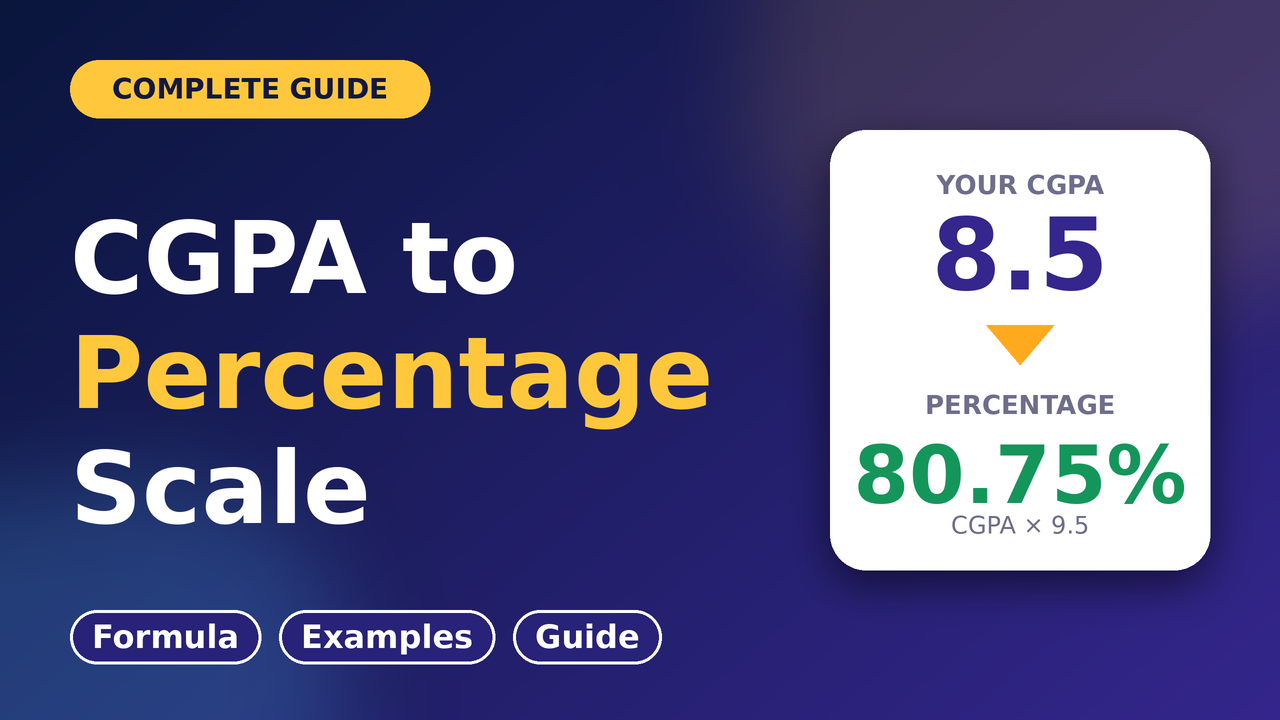
A common method for converting CGPA to percentage is to multiply the CGPA by a specified conversion factor. For example, if an institution states that percentage equals CGPA × 9.5, a CGPA of 8.0 would become 76%. However, this example should not be treated as a universal rule.
For a 4.0 grading system, some institutions may use a different approach. The correct formula depends on the grading system and academic authority. Students should use the official formula whenever one is provided rather than assuming that every CGPA follows the same conversion.
- Identify your CGPA.
- Identify your grading scale.
- Check your institution’s formula.
- Apply the approved conversion factor.
- Calculate the resulting percentage.
- Round the answer if required.
- Check your calculation carefully.
- Use official records when available.
CGPA to Percentage Formula
The basic formula depends on the conversion policy used by the institution. A commonly used formula is Percentage = CGPA × Conversion Factor. If the conversion factor is 9.5 and the CGPA is 7.5, the calculation would be 7.5 × 9.5 = 71.25%.
Another approach may use the maximum CGPA and maximum percentage. For example, a proportional formula can be written as Percentage = (CGPA ÷ Maximum CGPA) × 100. This method is mathematically straightforward but should only be used when it matches the institution’s stated policy.
- Formula may vary by institution.
- Check the maximum CGPA.
- Find the approved conversion factor.
- Multiply CGPA by the factor.
- Use proportional conversion when authorized.
- Avoid guessing the formula.
- Keep decimal places accurate.
- Verify the final percentage.
CGPA to Percentage Examples
Suppose a student has a CGPA of 8.2 on a 10-point scale, and the institution uses a factor of 9.5. The percentage would be 8.2 × 9.5 = 77.9%. This example demonstrates how a conversion factor works rather than establishing a universal academic standard.
For a proportional calculation, suppose the CGPA is 3.2 on a 4.0 scale. The calculation would be (3.2 ÷ 4.0) × 100 = 80%. Some institutions may instead use their own GPA-to-percentage table or formula, so students should confirm the required method.
- 8.2 × 9.5 = 77.9%.
- 3.2 ÷ 4.0 × 100 = 80%.
- 9.0 on a 10-point scale may be highly competitive.
- 7.5 can represent strong academic performance.
- 3.0 on a 4.0 scale equals 75% proportionally.
- Conversion depends on the grading policy.
- Examples are useful for checking calculations.
- Official formulas should take priority.
CGPA, GPA, and Percentage Difference
CGPA, GPA, and percentage are related but they are not the same measurement. GPA generally represents academic performance for a specific semester, term, or set of courses, while CGPA represents cumulative performance over a longer period. Percentage expresses performance as marks out of 100.
Students may encounter different GPA scales when applying to universities or jobs. A 4.0 GPA scale is common in many countries, while other institutions use 5.0 or 10.0 systems. Because grading systems differ, direct comparisons should be made carefully and according to official conversion standards.
- GPA can represent one academic term.
- CGPA usually covers multiple terms.
- Percentage is expressed out of 100.
- GPA and CGPA use grade points.
- Different countries use different scales.
- Institutions may publish conversion tables.
- GPA scales are not universally identical.
- Always identify the original grading system.
Why Is CGPA to Percentage Conversion Important?
CGPA to percentage conversion is important because many academic and professional applications request results in a specific format. Students applying for scholarships, internships, jobs, admissions, or professional programs may need to provide a percentage even when their transcript reports CGPA.
Accurate conversion also prevents misunderstandings during application processes. An incorrect formula can produce an inaccurate academic percentage. When an institution provides a conversion certificate or official formula, that information should be used instead of an online estimate or general conversion rule.
- Useful for university applications.
- Helpful for scholarship applications.
- Often needed for job applications.
- Supports academic comparisons.
- Helps complete application forms.
- Reduces calculation errors.
- Makes academic results easier to understand.
- Official conversion documents are preferable.
How to Use a CGPA Percentage Calculator
A CGPA percentage calculator can make conversion faster and reduce manual calculation errors. Usually, the user enters the CGPA, selects the grading scale, chooses the appropriate conversion method, and receives the estimated percentage instantly.
However, an online calculator should be used carefully. The calculator can only provide an accurate result when the correct conversion formula is selected. If your university has a specific conversion policy, enter the required factor or follow the institution’s stated method.
- Enter your exact CGPA.
- Select the correct CGPA scale.
- Choose the appropriate formula.
- Enter the conversion factor if required.
- Check the displayed percentage.
- Compare it with your transcript.
- Confirm institutional requirements.
- Keep official documentation for applications.
Final Thoughts on CGPA to Percentage Scale
The CGPA to percentage scale provides a convenient way to express grade-point performance as a percentage. However, there is no universal conversion formula for every university or country. The correct calculation depends on the grading system, maximum CGPA, and official academic conversion policy.
Before submitting your percentage for admission, employment, or scholarships, verify the required formula. Understanding CGPA, GPA, percentage, grade points, and GPA scales can help students accurately present their academic achievements and avoid unnecessary calculation mistakes.
- CGPA represents cumulative performance.
- Percentage represents marks out of 100.
- GPA usually represents term performance.
- Conversion rules vary by institution.
- Use official formulas whenever available.
- Check your grading scale first.
- Avoid assuming one formula works everywhere.
- Verify important results before submission.