

What Are GPA Scales?
GPA scales are grading systems used by schools, colleges, and universities to measure a student’s academic performance. GPA stands for Grade Point Average; a numerical representation of grades earned across courses. Depending on the institution, a GPA may use a 4.0, 5.0, or another grading scale to summarize academic achievement.
Understanding GPA scales helps students interpret report cards, evaluate academic progress, and understand admission requirements. Although GPA is widely used in the United States, other countries may use percentages, letter grades, divisions, or different numerical systems. Knowing which grading scale applies to your institution is essential for interpreting your results accurately.
Understanding the 4.0 GPA Scale
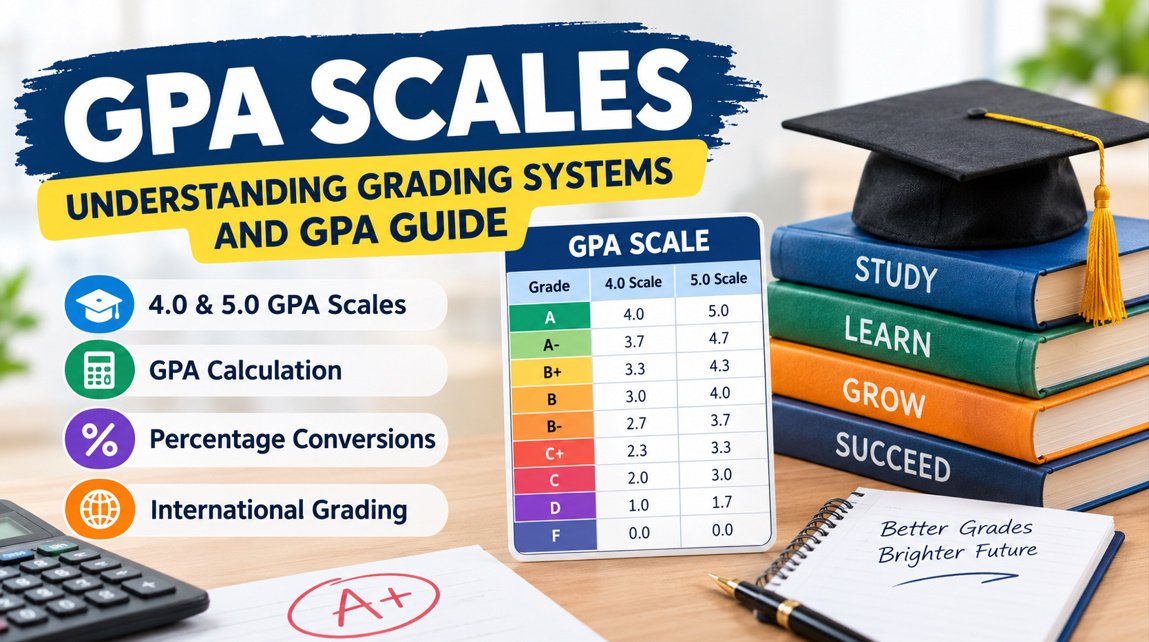
The 4.0 GPA scale is one of the most widely recognized grading systems in American education. In this system, an A commonly represents 4.0 grade points, a B represents 3.0, a C represents 2.0, and a D represents 1.0. An F generally represents 0.0 points, although institutional policies can vary.
Some schools use plus and minus grades to provide more precise measurements of academic performance. For example, an A-minus might equal 3.7, while a B-plus might equal 3.3. These values are not universal, so students should consult their school’s official grading policy before calculating a GPA or comparing academic results.
- 4.0 GPA: Common undergraduate grading scale.
- Grade points: Numerical values assigned to grades.
- Letter grades: A, B, C, D, and F.
- A grade: Often represents excellent performance.
- B grade: Commonly represents good performance.
- C grade: Usually represents satisfactory performance.
- D grade: May indicate minimum passing performance.
- F grade: Generally, represents a failing grade.
- GPA calculation: Uses course grade points and credits.
- A-minus: Often equals 3.7 on a 4.0 scale.
- B-plus: Often equals 3.3 on a 4.0 scale.
- Credit hours: Determine course weighting.
- Grading policy: Varies by institution.
- Academic transcript: Records official course grades.
- Semester GPA: Measures one semester’s performance.
- Cumulative GPA: Measures performance across multiple semesters.
Understanding the 5.0 GPA Scale
A 5.0 GPA scale allows institutions to assign grade points on a five-point framework. Some schools use weighted GPA systems in which advanced, honors, or challenging courses receive additional points. Under such a system, a student may earn more than 4.0 points in an eligible course, depending on the institution’s grading rules.
It is important to distinguish a true five-point grading system from a weighted GPA calculation. A 5.0 GPA does not automatically mean a student has performed better than someone with a 4.0 GPA. The maximum points, course difficulty adjustments, and grading rules must be understood before comparing results between schools.
- Maximum GPA: May be 5.0.
- Weighted courses: May receive additional points.
- Honors classes: Sometimes use weighted grading.
- Advanced courses: May carry extra grade points.
- Unweighted GPA: Usually follows a standard scale.
- School policy: Determines the exact calculation.
- GPA comparison: Requires the same grading context.
- Academic rigor: Can affect weighted GPA results.
How to Calculate GPA Using Grade Points
Calculating GPA involves converting course grades into grade points and accounting for credit hours. Most credit-based systems use a weighted average, meaning a course with more credits has a greater influence on the final GPA. Students can calculate their semester GPA by multiplying each course’s grade points by its credit hours.
The basic formula is GPA = total quality points divided by total GPA-counted credit hours. For example, a student earns 4.0 points in a three-credit course and 3.0 points in a two-credit course. The total is 18 quality points divided by five credits, resulting in a GPA of 3.6.
- Step 1: List all courses.
- Step 2: Record each course’s grade points.
- Step 3: Identify credit hours.
- Step 4: Multiply points by credits.
- Step 5: Add the weighted points.
- Step 6: Add the included credit hours.
- Step 7: Divide total points by total credits.
- Step 8: Round according to institutional rules.
GPA Scales Compared With Percentage and Letter Grades
Schools can report academic achievement using percentages, letter grades, or grade point averages. A percentage shows marks earned out of the total available, while a letter grade summarizes performance within a defined range. GPA converts grades into numerical points, making it easier for institutions to calculate semester averages and cumulative academic results.
However, there is no universal percentage-to-GPA conversion that applies to every school. For instance, an 85% score may correspond to different letter grades or grade points under different grading policies. Students applying internationally should use the official conversion table required by their target institution rather than relying on a generic online calculator.
- Percentage grade: Expressed as a score out of 100.
- Letter grade: Uses symbols such as A or B.
- Grade point: Assigns a numerical value to a grade.
- GPA: Summarizes performance across courses.
- Conversion table: Maps grades between systems.
- Passing mark: Depends on institutional rules.
- International applications: May require credential evaluation.
- Official records: Take priority over estimates.
Semester GPA vs. Cumulative GPA (CGPA)
Semester GPA measures academic performance during a single academic term, such as a fall or spring semester. It reflects the grade points earned in courses completed during that period. Students can use semester GPA to track short-term academic progress, identify challenging subjects, and understand how their performance changes between terms.
Cumulative GPA, commonly called CGPA, measures performance across multiple semesters or an entire academic program. It generally combines grade points and credit hours from all included courses, subject to the institution’s rules. For example, a student may earn a 3.2 GPA in one semester and a 3.6 in another, resulting in a cumulative GPA determined by the credits and grades from both semesters.
- Semester GPA: Covers one academic term.
- CGPA: Covers multiple academic terms.
- SGPA: Another abbreviation for semester GPA.
- Credit weighting: Influences both calculations.
- Academic progress: Can be tracked term by term.
- Graduation eligibility: May depend on minimum CGPA.
- Repeated courses: May follow special calculation rules.
- Transcript review: Helps verify official results.
International GPA Scales and University Requirements
GPA scales differ across countries, educational institutions, and degree programs. American universities commonly use a 4.0 scale, while some institutions use five-point systems or other numerical frameworks. In Pakistan, many universities use a 4.0 GPA scale, but the precise relationship between marks, letter grades, and grade points depends on the university’s published grading policy.
University of Sargodha
+1
International students should pay close attention to these differences when applying for scholarships, undergraduate programs, postgraduate degrees, or student exchange opportunities. An institution may request an official transcript, a credential evaluation, or a specific GPA conversion method. A simple mathematical conversion may not reflect the academic standards or grading practices of the institution that issued the original qualification.
- United States: Commonly uses a 4.0 scale.
- Pakistan: Many universities use a 4.0 scale.
- Five-point systems: Apply institution-specific grade mappings.
- International admissions: Follow the receiving university’s rules.
- Scholarship eligibility: May include minimum GPA requirements.
- Official transcripts: Provide verified academic results.
- Credential evaluation: May be required for foreign qualifications.
- Conversion accuracy: Depends on the official grading policy.
How to Improve and Maintain a Strong GPA
Maintaining a good GPA starts with understanding course requirements, assessment weightings, and the grading system used by your school or university. Students can benefit from a consistent study schedule, regular revision, timely assignment submission, and asking teachers for clarification when topics are difficult. Reviewing grades throughout the semester can also help identify areas that need more attention.
A strong GPA is built through steady progress rather than a single examination result. Students should set realistic academic goals, monitor deadlines, and use feedback to improve their performance. It is also important to understand institutional policies on retaking courses, withdrawing from classes, and academic probation, because these rules can affect GPA calculations and progress toward graduation.
- Set goals: Establish realistic academic targets.
- Plan study time: Follow a consistent weekly schedule.
- Attend classes: Keep up with course material.
- Submit assignments: Meet deadlines whenever possible.
- Review feedback: Learn from mistakes and corrections.
- Seek support: Ask teachers or tutors for help.
- Monitor grades: Check academic progress regularly.
- Know the rules: Understand GPA and graduation requirements.